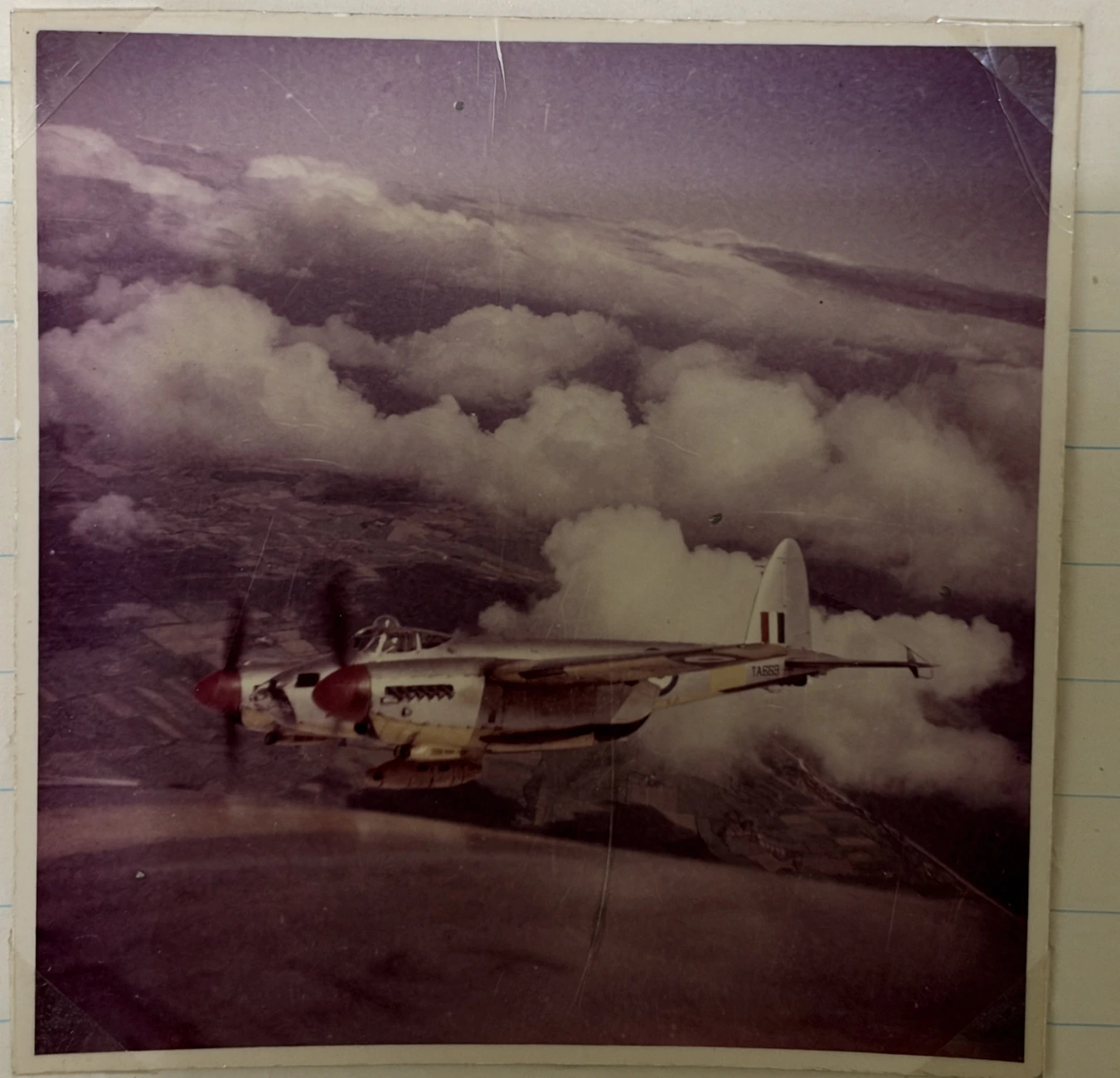
Header: the photograph labelled “Before” in Dad’s album. View the full photograph.
I was five when my father, Roland Godfrey Pickering, survived a Mosquito crash while we were living in Schleswig, in northern Germany. The date was 21 November 1956.
Looking at the photograph of the wreckage now, I find it difficult to understand how either man came out alive, let alone without serious injury. Dad and the pilot, Frank Jones, survived. In his own account, Dad described bruises and scratches, X-rays, treatment for shock and five days in hospital.
He left us something more valuable than a story passed down through the family: his own handwritten account.
A story in an exercise book
Dad attended an English course at Wulfrun College of Further Education. I believe it was intended to help him progress through the ranks in the RAF, although that is my understanding rather than something established by these pages.
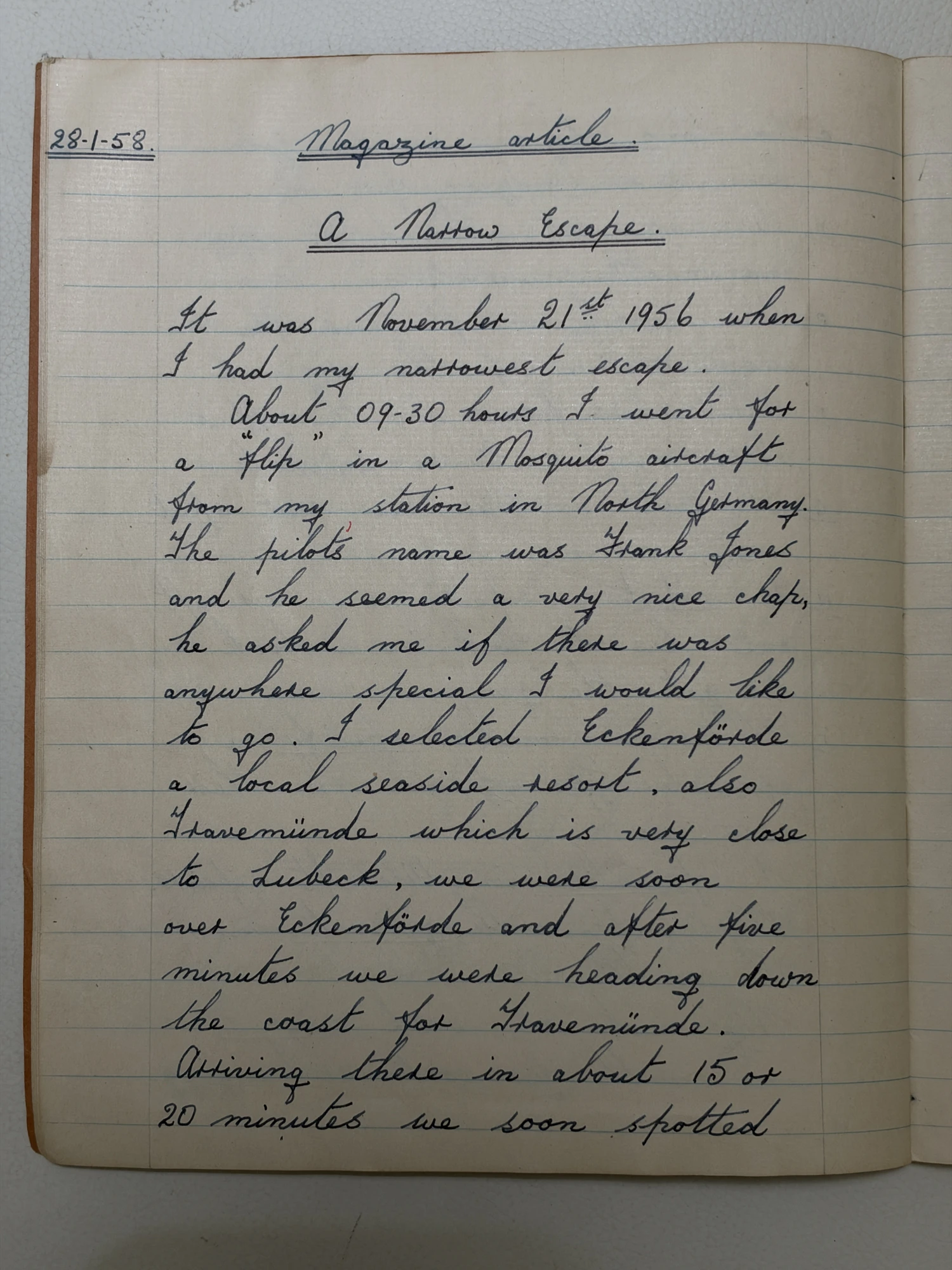
His exercise book contains an entry dated 28 January 1958, headed “Magazine article” and titled A Narrow Escape. He was writing about an event a little over a year earlier. The account is direct, understated and all the more powerful for it.
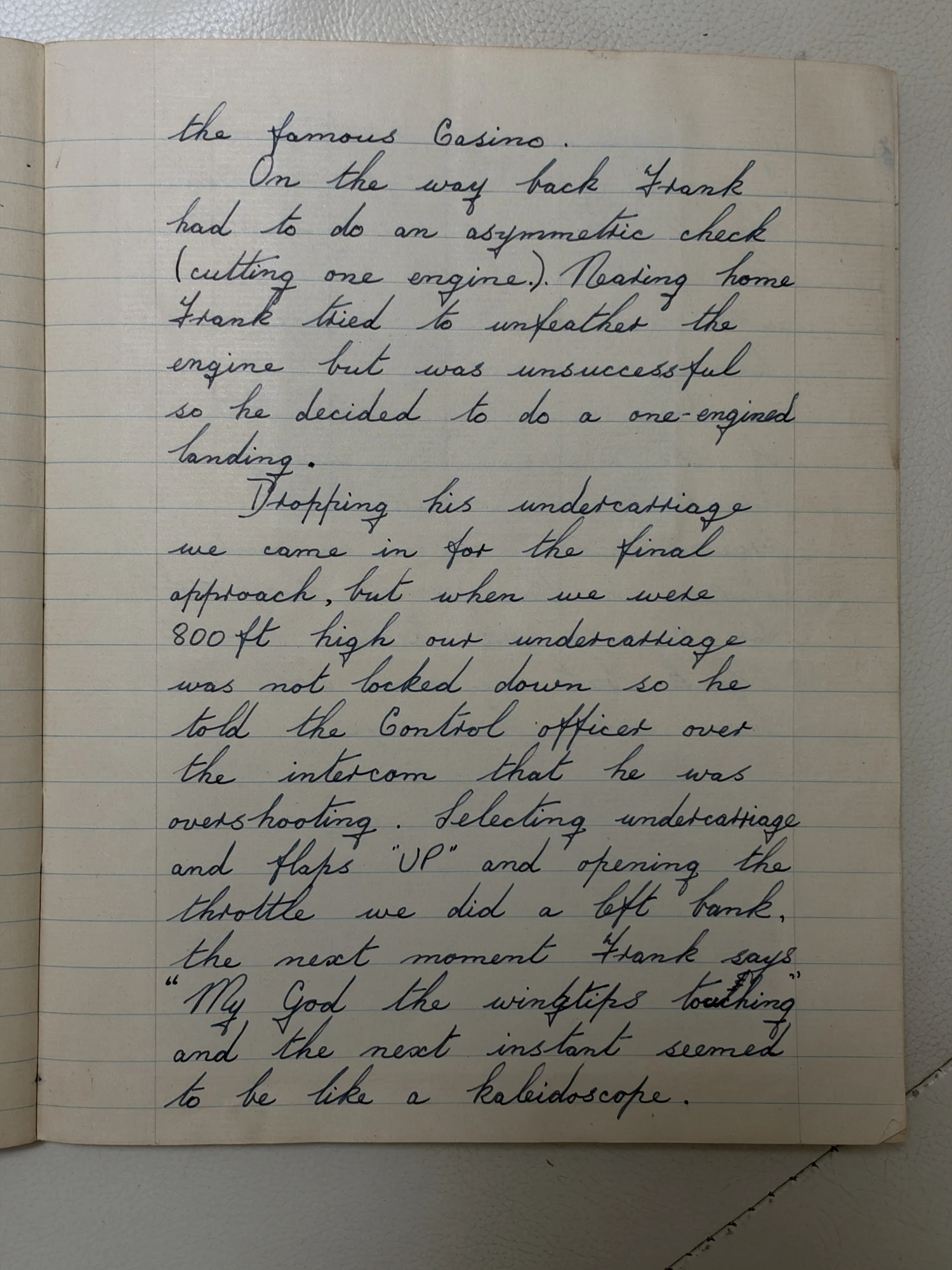
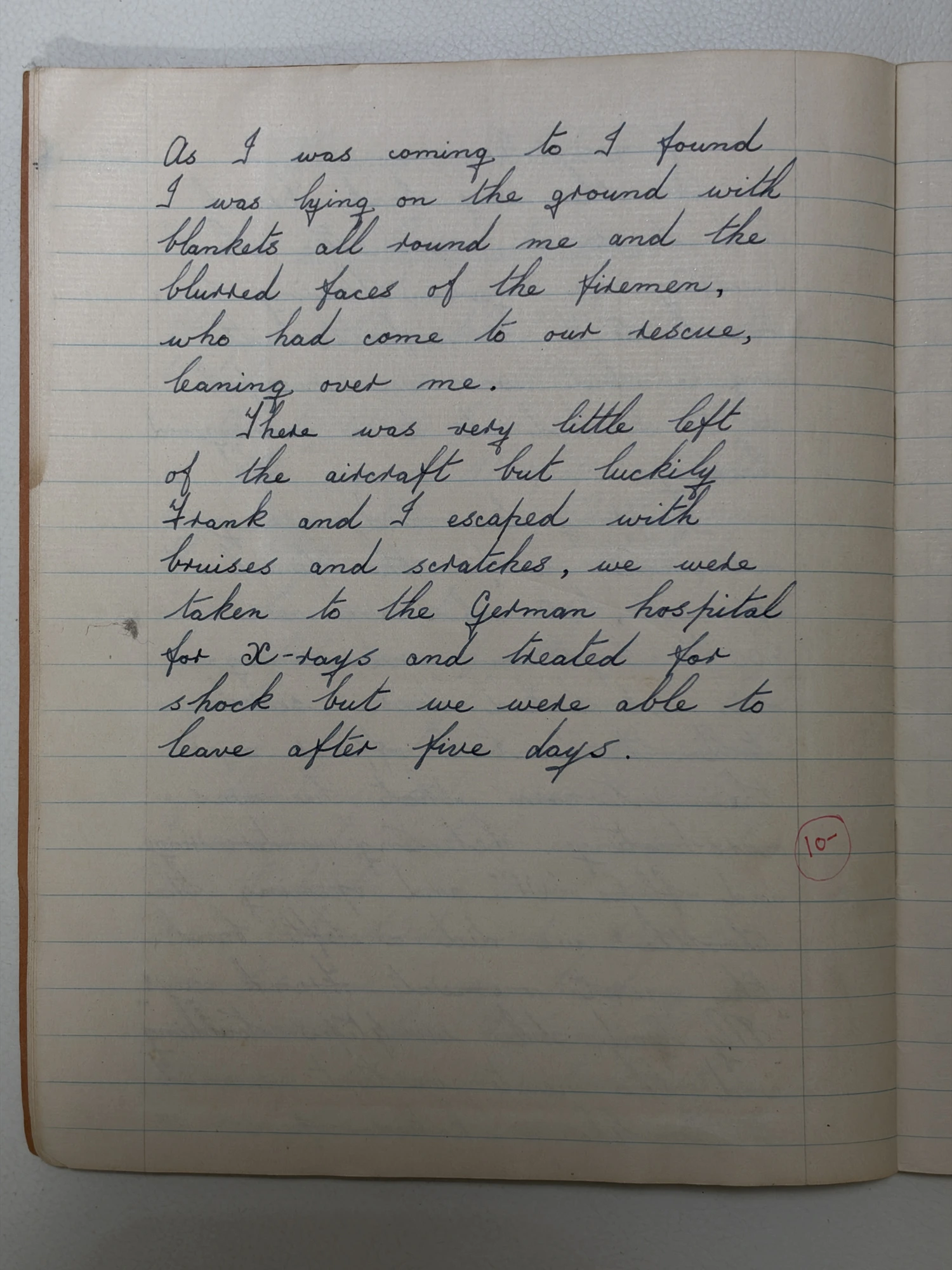
These are his words, transcribed from the three pages, with the paragraph layout and quotation marks regularised. The place-name spelling “Eckenförde” is retained as he wrote it.
It was November 21st 1956 when I had my narrowest escape.
About 09-30 hours I went for a “flip” in a Mosquito aircraft from my station in North Germany. The pilot’s name was Frank Jones and he seemed a very nice chap, he asked me if there was anywhere special I would like to go. I selected “Eckenförde” a local seaside resort, also “Travemünde” which is very close to Lübeck, we were soon over Eckenförde and after five minutes we were heading down the coast for “Travemünde”. Arriving there in about 15 or 20 minutes we soon spotted the famous Casino.
On the way back Frank had to do an asymmetric check (cutting one engine). Nearing home Frank tried to unfeather the engine but was unsuccessful so he decided to do a one-engined landing.
Dropping his undercarriage we came in for the final approach, but when we were 800ft high our undercarriage was not locked down so he told the Control officer over the intercom that he was overshooting. Selecting undercarriage and flaps “UP” and opening the throttle we did a left bank, the next moment Frank says “My God the wingtips touching” and the next instant seemed to be like a kaleidoscope.
As I was coming to I found I was lying on the ground with blankets all round me and the blurred faces of the firemen, who had come to our rescue, leaning over me.
There was very little left of the aircraft but luckily Frank and I escaped with bruises and scratches, we were taken to the German hospital for X-rays and treated for shock but we were able to leave after five days.
What was left
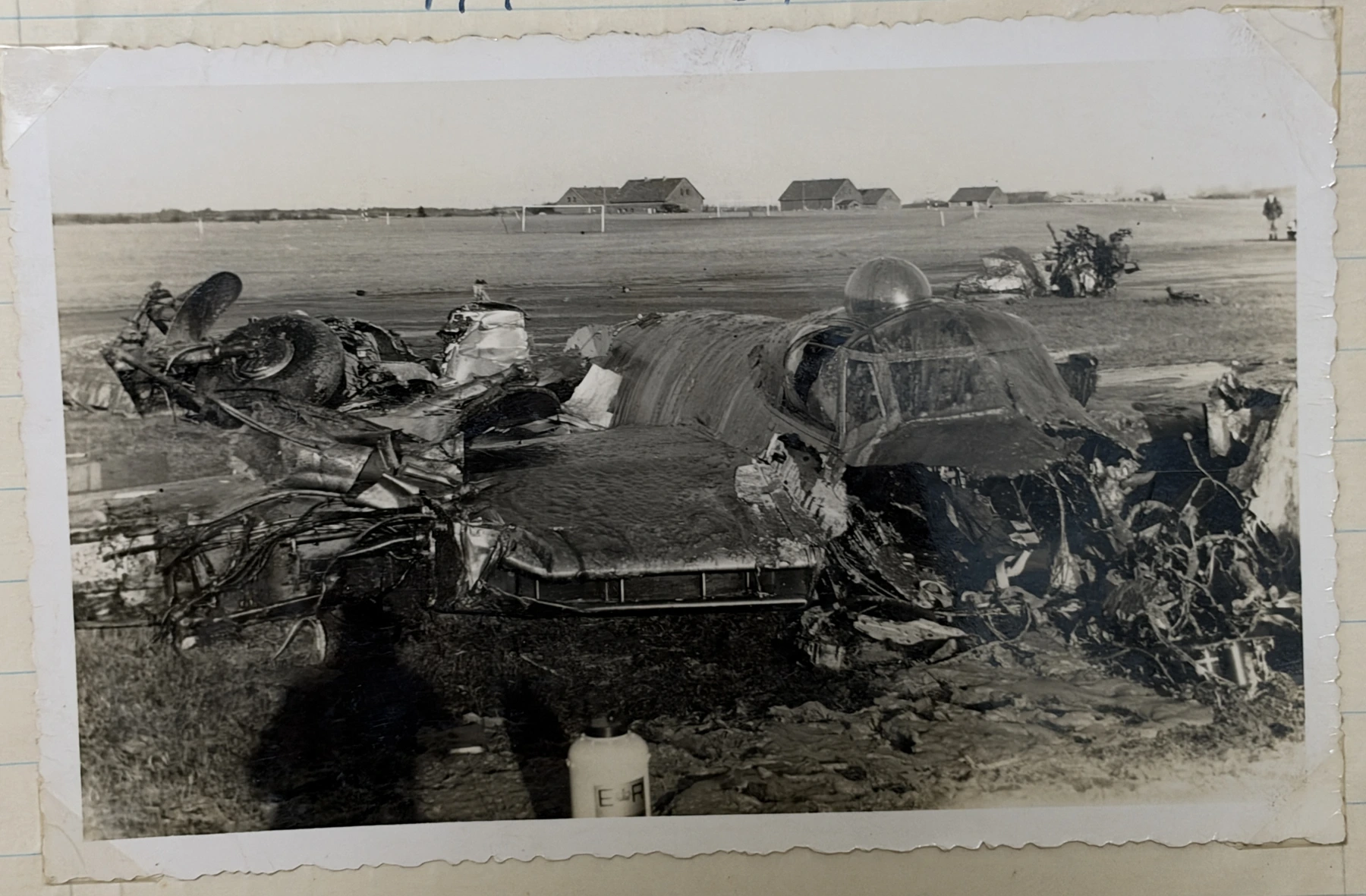
Dad sat on the right, lower than the pilot. When I look at the damage around the front of the aircraft, I think about where he had been sitting. It seems extraordinary that he did not lose his legs, or his life.
I cannot explain their survival from a photograph. His account tells us what he remembered of the approach, the sudden bank, the impact and waking on the ground. It does not tell us every detail of how the aircraft broke apart or how the two men were protected. I would rather leave that uncertainty than invent an explanation.
The missing shoe
Many years later, while building my websites, I managed to contact one of the firemen who had attended the crash and helped get Dad out of the wreckage.
He remembered Dad being particularly concerned about a missing shoe. It had come off in the crash, and the pair was new—he had only just bought them.
Dad had survived an aircraft crash, and he wanted his new shoe back.
I suspect he was shocked and not thinking entirely clearly, but that is my interpretation. The fireman’s recollection was the concern about the shoe. Dad’s own writing confirms that he was treated for shock.
It is such a small, human detail alongside that extraordinary photograph. I cannot look at the wreckage without thinking how easily my family’s story could have ended differently.
In his own hand
The original pages are part of our family archive. Select a page to read it at a larger size.
Sources: Dad’s exercise-book account dated 28 January 1958; the photographs labelled “Before” and “After” in his album; and my recollection of the later conversation with one of the attending firemen. The photographs have been rotated and cropped for display, with their original appearance retained.