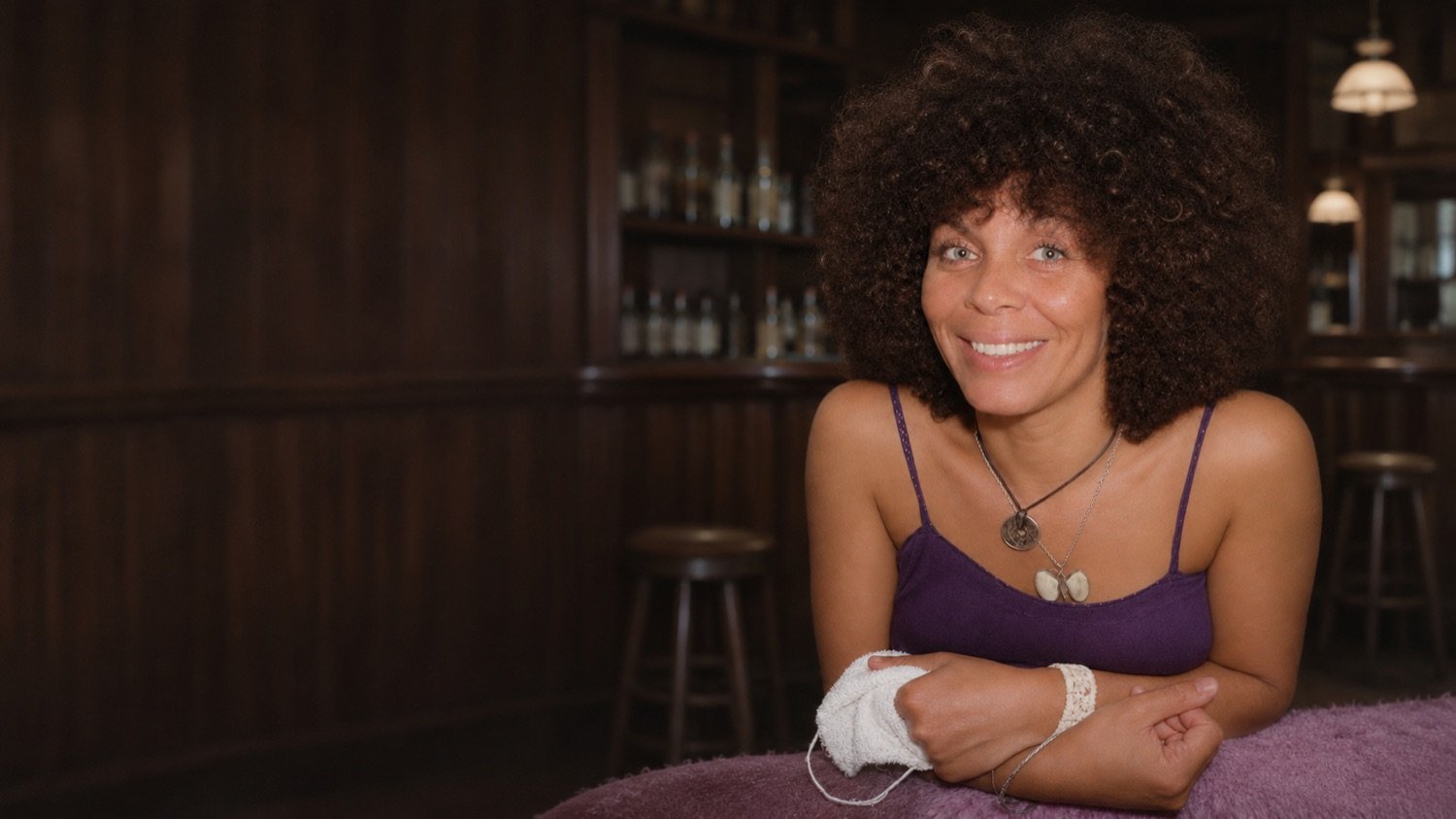
Susie, who worked behind the bar at Cleo’s. The bar backdrop is a reconstruction.
In the late seventies, my business partner and I bought the leasehold of the Cleopatra Hotel in Fremantle. Everyone called it Cleo’s. We bought the fixtures, fittings and stock along with the lease, and the seller let us pay in instalments. We thought we’d found a way into the hotel trade without having to put up all the money at once.
I was soon learning how to run a pub. It took me a little longer to work out what sort of pub we’d bought.
One pair of shoes
Cleo’s drew regulars from all over Fremantle, including a strong crowd from the local Noongar community. One of the people who made the place was Susie, an Englishwoman of Jamaican heritage who was already on the staff when we took over. She was tall, with a wonderful Afro and a low, smoky voice. You could hear her laugh from the other end of the bar. Some people swore she was the Cleo the hotel was named after. We saw no need to spoil a good story.
I decided that if we wanted to smarten the place up, we could start by asking people to wear shoes. The bouncers assured me they were enforcing the rule. Yet I kept seeing people inside in thongs or bare feet. It made no sense until I worked out that a pair of shoes was going back out through the toilet window. The next man would put them on, walk past the bouncers and send them back for his mate. I’d said everyone had to wear shoes. I hadn’t thought to say they had to be different shoes.
I also tried opening the cocktail bar as a place where gay customers could feel welcome. It took off. Some drinkers in the other bars made their objections known, and we had trouble between the rooms. I’d imagined I could change the atmosphere by opening a door. I hadn’t given enough thought to what would happen in the corridor.
Live music, just about
As I remember it, our extended licence let us trade until midnight if we served food and had live entertainment. Some of the regulars had been asking me to book an Aboriginal band, so we put one on for a Saturday night. The place was full, and for the first hour it was everything we’d hoped for.
By nine, two of the musicians had fallen off the stage. They’d been getting through the Swan Lager faster than they were getting through the set. Once we’d helped them out, I had a pub full of people, three hours left to trade and a sudden shortage of live entertainment.
We put a staff member beside the jukebox and asked them to sing along. As long as somebody kept feeding it coins, we had a singer. The Liquor Squad came in that night. My recollection is that they let us finish the evening and made it clear they wouldn’t care to see a repeat performance. Neither, I imagine, would the singer.
Eighteen in, six sold
The number that mattered when we bought Cleo’s was eighteen. In those days, a pub’s weekly keg sales told you a great deal about what the business was worth. The brewery dockets showed eighteen full kegs going in and eighteen empties coming back. It looked like a straightforward trade.
Once we were behind the bar, we could sell only six a week. At first I wondered how we could possibly be getting it so wrong. Later, I came to believe that some of the beer delivered to Cleo’s had been going to another pub. Eighteen deliveries and eighteen returns could balance beautifully on paper without eighteen kegs ever going through our taps.
We stopped paying the instalments, wound up our time at Cleo’s and took out the remaining stock and what we could remove. By my reckoning, we came out about even.
I still think about that one pair of shoes. The trick worked because the bouncers saw a man wearing shoes each time they looked. I’d done much the same thing with the brewery dockets. I’d counted what came through the door and assumed I knew what happened to it after that.
After Cleo’s, my business partner Tony and I headed to Singapore. Read what happened next in “Eh, Tony, Why Like That?”