Adapted from A Life in Stories — An Expanded Family Memoir, Family Edition, Version 6.
We flew from Stansted on a BOAC Britannia. I was eleven, almost twelve, and more interested in the adventure than in the practical difficulties my parents were carrying.
Aden announced itself with heat.
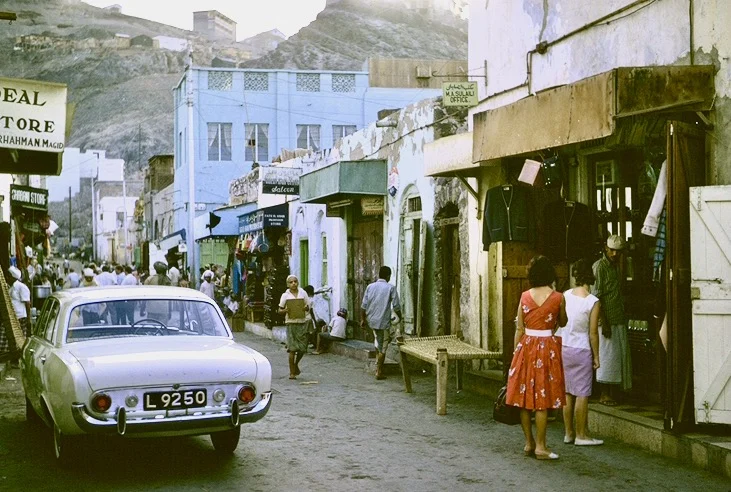
England had greys and greens. Aden was glare, rock and dust, with buildings pressed against a landscape that looked as though somebody had forgotten to add vegetation. Crater was exactly what the name suggested: a town inside an extinct volcanic crater.
We first lived in a privately rented ground-floor flat there. I remember the Arabic voices, the smells from the shops and the light that seemed to sharpen every edge. For a boy who disliked being told the world was limited, it was intoxicating.
During one of Aden’s rare rainstorms, water rushed down through Crater, carrying debris, animals and makeshift structures with it. Then, for a brief time, the surrounding rock turned green. I remember the transformation almost more than the destruction. A place that looked incapable of supporting softness suddenly showed that life had been waiting underneath.
Mum’s health was poor in Crater, so we moved to an air-conditioned flat at Dhobi Lines in Khormaksar. Dogs weren’t allowed there, and we had to say goodbye to Tess, the local dog Dad had brought home.
School in the heat
From Crater it was a thirty-minute ride on a hot bus to Khormaksar Secondary School. We wore white short-sleeved shirts with the school logo on the pocket, white shorts and socks, and beige chukka boots. We carried our books in woven shopping bags. School ran from seven in the morning to lunchtime, before the heat could flatten the day.
My summer 1963 report was mostly A’s and B’s. I’d already done much of that term’s work in England, so I could coast and still look clever. By December 1964, I was getting mostly C’s, with one B in art. “Early promise not maintained,” wrote one teacher. Another put it plainly: “Photography is not enough on its own.” Dad didn’t hit the roof, which surprised me. The evidence was clear, though: school and I were not going to be a love story. Photography was another matter.
Life in the evenings
Most businesses shut in the afternoon and opened again around five, when the heat let up. Once Mum and Dad had finished their afternoon gonk, we’d pile into Dad’s green open-top Austin A40 and head to Crater or Steamer Point to shop, wander and watch the world go by.
One day we came back to find several goats inside the Austin, happily eating the seat covers. After that, Dad paid local boys to keep the goats away whenever he parked. It was probably cheaper than buying new seats every week.
Sometimes we braved the daytime heat and went to the beach at Little Aden or to the Lido at Steamer Point. The Lido had a shark net, which Dad said was “more holy than righteous”. We all went in anyway. I liked looking for empty drink bottles on the beach and taking them back to the kiosk for the refund.
I picked up bits of Arabic and grew comfortable moving between the RAF world and the shops and streets beyond it. If I had enough money for a taxi, I could head out from Khormaksar Shopping Centre to fish.
That comfort with difference stayed with me. Years later I would live in Singapore, Malaysia, Indonesia and Thailand. Aden was the first place that taught me that being the foreigner did not have to mean being frightened. It could mean paying attention.