In 2011, when I was fifty-nine, Delima and I went to Bukit Lawang in northern Sumatra for the day. We hired a private guide to take us into the rainforest to see orangutans.
The track was slippery from the start. It was steep in places, and the humidity had my shirt sticking to me long before there was any rain. After about two hours I began to slow down. Our guide had recently had to help bring a tourist out after a medical emergency, so he was watching me rather more closely than I would have liked. I couldn’t entirely blame him.
He left us to rest in a small clearing under a banyan tree while he went ahead. About half an hour later he came back. “I’ve found them,” he said. It was remarkable how much better my legs felt on hearing that.
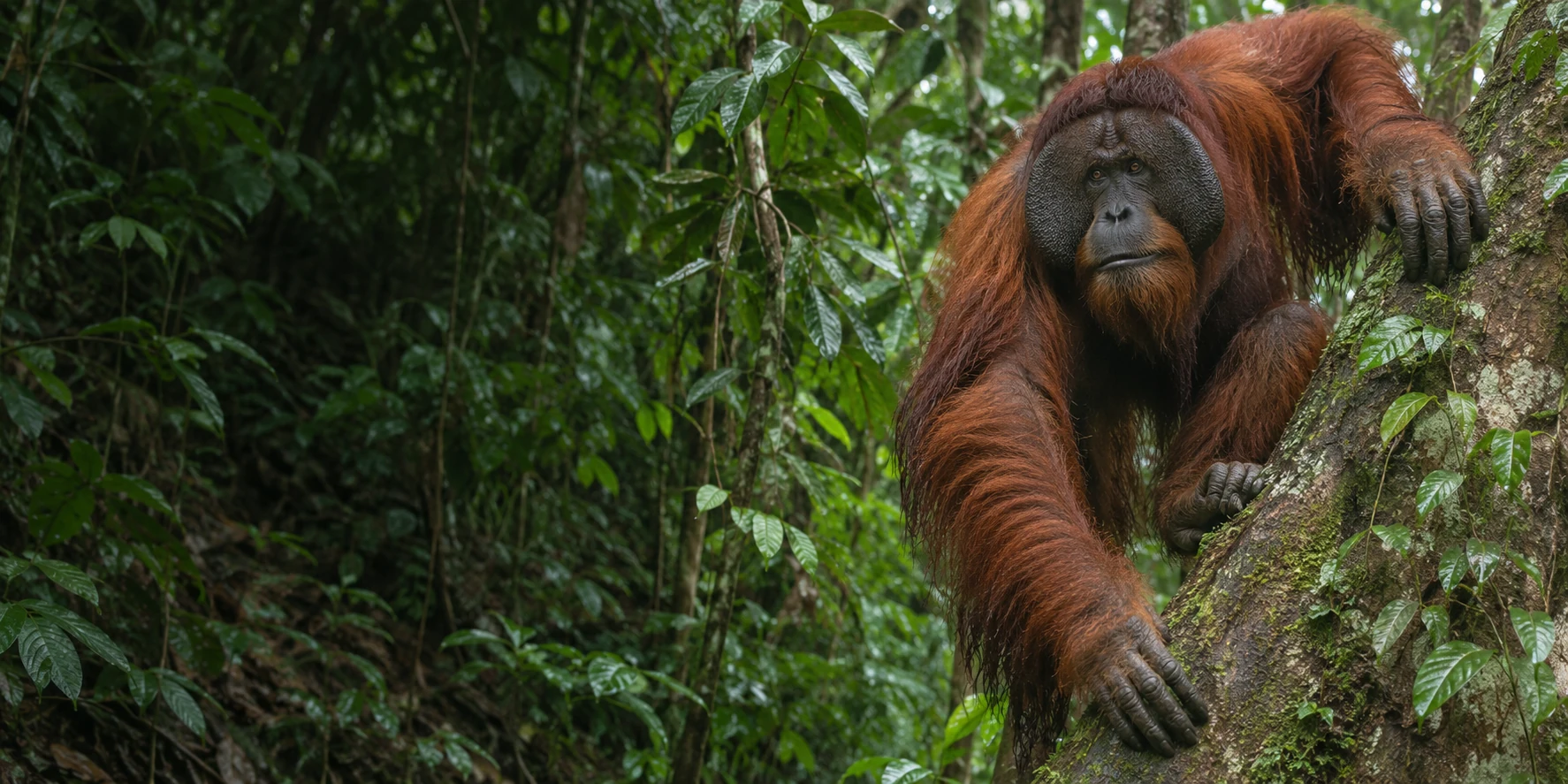
We followed him up another slippery stretch. Then he held up a hand, and we stopped. A large male orangutan was coming down a tree, one long arm reaching below the other. He had shaggy copper-coloured hair and broad cheek pads. I’d expected him to be big. What surprised me was how quietly he moved.
What stayed with me most was his eyes. For a moment he looked straight at me, and I wondered what he made of us. There was a depth to that look that I still find hard to describe. It felt as though something passed between us. Perhaps that was just me imagining it. There was no way to ask him.
Other orangutans watched from higher in the branches. Our guide knew the big male and warned us to keep still. He could be aggressive, and a sudden movement might set him off. The guide held out a banana, and the orangutan took it. Then he climbed back up the trunk. In a few moments they were all gone, and we were staring at leaves again.
Getting back across the river
On the way back, our guide kept looking up. The sky was darkening, and we still had the river to cross. A flash flood had swept through Bukit Lawang in 2003. Our guide knew how quickly that river could rise.
When the rain came, the track grew slicker and we hurried as best we could. By the time we reached the river, it was churning and the canoe operators had stopped for the day. Our guide talked them into taking us across. Once we were in the dugout, there were only about five centimetres between the water and the top edge. I’d have been happier with a bit more.
The operators used ropes to guide the canoe across. My mind flashed back to Kenya, to the crossing near Mombasa on our way to Tsavo National Park. The ropes reminded me of The Singing Ferry, though there was no singing or stamping of feet this time.
The current was roaring, and those five centimetres had my full attention until the hull bumped the far bank. Delima and I climbed out drenched and very glad to be on solid ground.
Back across the river, I noticed a man selling handicrafts from a doorway at the riverside resort. His white hair fell in loose curls around his ears, and he had a white moustache and a wispy beard. There was something friendly about his face. I sat down with him and we talked for quite a while. He spoke English very well, and I knew enough Indonesian for us to go back and forth between the two.

He told me he’d been away when the Bohorok River flooded on the night of 2 November 2003. His wife, who was German, was among those killed. I wondered if he’d picked up some of his English from her. I never asked.
After days of heavy rain, the river swept through Bukit Lawang while people slept, carrying uprooted trees and tearing away houses, guesthouses and bridges. The first reports put the death toll at 72 or more. By the time Down to Earth reported on the flood that November, more than 130 deaths were known. Indonesia’s disaster atlas later recorded 160 deaths and 140 people missing.
Accounts differed on what set the flood loose. Down to Earth described a small dam giving way and reported that officials blamed illegal logging. The disaster atlas described rain-triggered landslides carrying timber into a narrow stretch of the river, where it formed a blockage that eventually gave way.
After the crossing we’d just had, and with our guide’s warning still fresh in my mind, I couldn’t get over how quickly the river had changed. I wondered why people had rebuilt so close to it, and what it was like for him to go on living there after losing his wife. I still think about that conversation. He looked to be about sixty then, roughly my own age. I wonder what the years have brought him, and whether he’s still there.
We’d gone to Bukit Lawang to see orangutans. Seeing them that close in the wild was a once-in-a-lifetime experience. I remember the big male taking the banana as clearly as I remember the river and the man in the doorway.