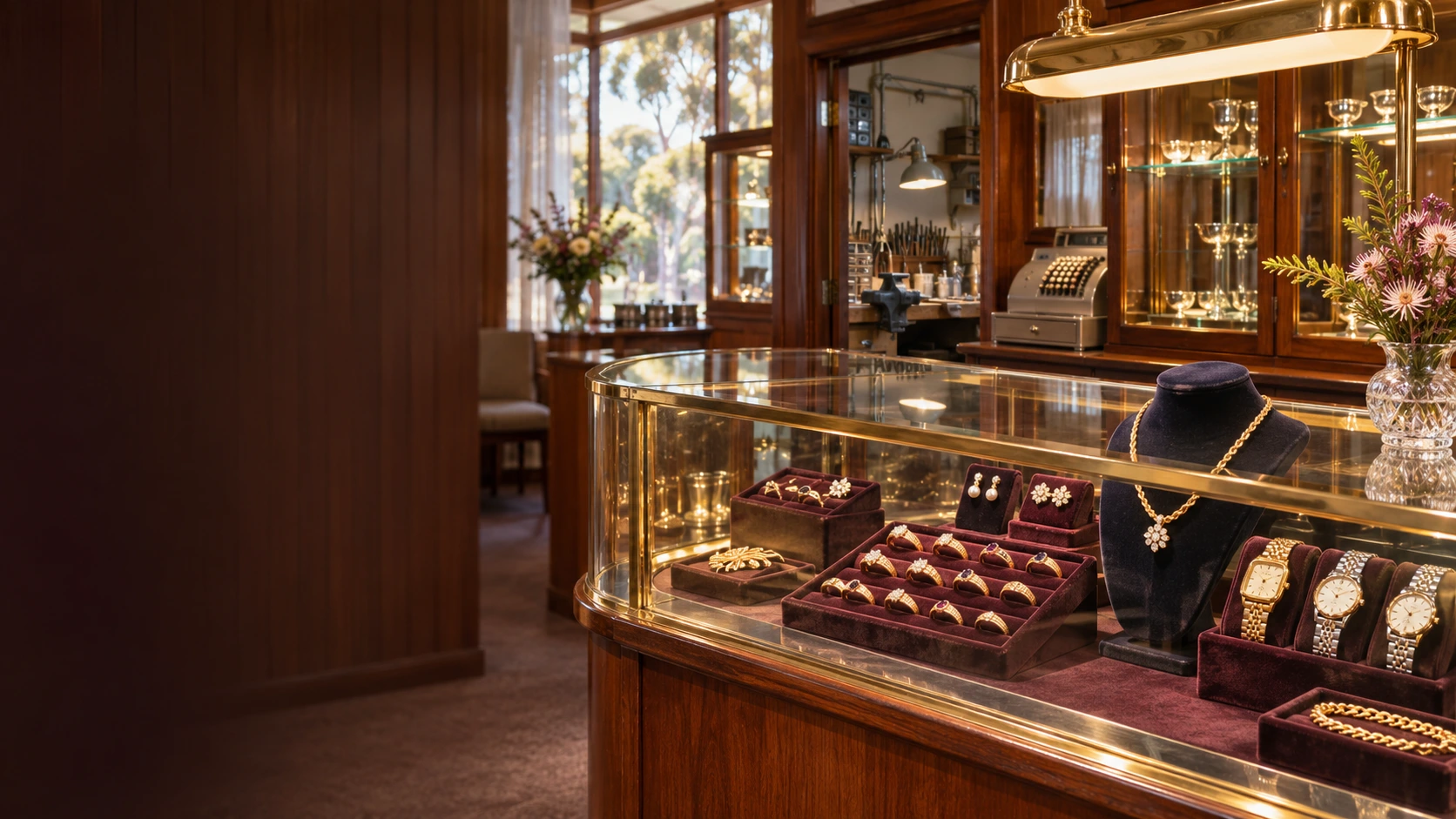
Header illustration: an imagined jewellery shop of the period, rather than a photograph of Burlington’s premises.
I bought Burlington Jewellers from a liquidator for one dollar.
Not a thousand dollars. Not a dollar followed by several discreet zeros. One dollar.
It still seems incredible when I say it now.
The business was in trouble, but I could see possibilities. Of course, paying a dollar did not turn it into a successful jewellery shop. There was a great deal to sort out, and that was where the interesting part began.
I have always enjoyed looking at a business and wondering what could be done differently. Sometimes the answer involves money. Quite often, it involves noticing something that everybody else has stopped noticing.
Burlington gave me plenty to notice.
The people behind the counter
There were staffing and management problems to resolve, but there were also good people whose abilities needed recognising.
Shirley Dobbs was already working there when I took over. She became the manager and, over time, much more like family than an employee. Two of her daughters sometimes worked in the shop too.
Mum and Dad worked there. My niece Nicky worked there. Later, Aunty Phil—Dad’s sister—and Uncle Tom joined us. Becky helped in the shop when she visited Australia.
It became a genuine family business, and I loved those days.
There is a particular pleasure in working alongside your parents as an adult. Mum and Dad were part of the everyday life of the shop: customers at the counter, repairs coming in, watches arriving and somebody making tea.
When I think of Burlington now, those are the people I see first.
A window worth stopping for
Shirley had a remarkable eye for display. I enjoyed finding unusual props for her to work with, and the windows became something people noticed rather than simply walked past.
One Easter, we put tiny live chicks on sawdust in the window, among the jewellery displays.
That certainly stopped people.
Children wanted to look at the chicks. Parents stopped with the children. While they were standing there, they also looked at the jewellery.
We had given them a reason to pause.
There were rather more conventional ways to advertise a jeweller, I suppose. But a small crowd outside the window was encouraging, even if some of its members were initially more interested in poultry than pendants.
The cheque nobody asked for
Another idea was to choose three repair customers each week and send them a letter with a cheque for a partial refund.
These were people who had already collected their jewellery or watches and paid their bills. They had not complained or asked for anything back.
The letter explained that we had achieved some cost savings and wanted to pass part of those savings on to them.
An unexpected cheque makes a rather different impression from another advertisement.
Customers were surprised and pleased, and they talked about it. The refunds cost far less than a conventional advertising campaign, while giving people a good reason to remember us and recommend the shop.
I liked that arrangement. Some of the money we might have spent telling people how good we were went directly to customers instead.
Something different in the cabinet
Stock was another area where I wanted more freedom.
If every shop has exactly the same watch, the customer can walk from one to the next comparing prices. There is not much else to discuss.
I began travelling to Singapore regularly to source watches, including Seiko and Citizen models that were different from those commonly offered by local suppliers.
It made the stock more interesting and gave us room to offer something distinctive. I enjoyed the buying trips too. Put me among watches, gadgets and people with things to sell, and I could keep myself occupied quite happily.
We also developed our own watch line, Genêve, and imported silver jewellery and silverware from Germany, including goblets and napkin rings.
Buying directly improved the economics of the business. But the goods still had to appeal to the person looking through the glass. A clever buying price is not much use if nobody wants what you bought.
Computers, laybys and skilled hands
I invested in an early computerised system for accounting, stock control and laybys.
It was a substantial expense in those days. We were in the 1980s, and putting those functions onto a computer was a considerable step for a small retailer.
I wanted better information and less unnecessary work. There was enough to do in a jewellery shop without making the paperwork more difficult than it needed to be.
We also brought repairs and jewellery manufacture in-house, employing skilled jewellers rather than relying entirely on outside contractors.
That gave us more control over the work and its costs. It also meant Burlington was a place where things were made and repaired, not simply somewhere finished goods changed hands.
I liked that. There is something satisfying about having skilled people able to turn a customer’s idea into an actual piece of jewellery.
Tea before the sales pitch
I wanted every person who entered the shop to be acknowledged. That did not mean following them around the cabinets. People should be able to look, while knowing somebody was ready to help.
When I served customers, I liked to sit down and talk. What were they looking for? What did they actually want? Sometimes we would have tea brought over.
Those conversations could be very productive. A customer might arrive with one idea and discover, through talking, what would suit them better.
Staff learned to show complementary pieces too: a bracelet to go with a necklace, or possibilities for a ring being redesigned. There was nothing mysterious about it. You had to pay attention to the person rather than simply the item in front of you.
And, naturally, I still enjoyed a barter deal.
I needed extensive dental work, and Alex was my dentist and oral-surgery friend. We arranged a contra involving an emerald-and-diamond ring.
Jewellery for teeth.
It seemed an entirely reasonable exchange to me. My later visit to watch Alex at work in an operating theatre was rather less comfortable, but that belongs to another story.
More than a bargain
The business became highly profitable. The dollar purchase had given me an opportunity, and the changes we made turned that opportunity into something worthwhile.
But I would not want to tell the story as though I handed over a coin, waved a wand and produced a flourishing shop. There were people working behind those counters, doing the repairs, keeping track of stock, arranging the windows and looking after customers.
Shirley mattered. Mum and Dad mattered. The family coming and going mattered.
I still enjoy the sheer absurdity of having bought a jewellery business for a dollar. It is a rather good opening line, and I am pleased to say it is true.
Yet the purchase price is not the part I miss.
I miss those days in the shop, with the people who made it what it was.
Alex, away from the jewellery counter
Read Dr. Pickering, I Presume? → for my visit to the operating theatre, or join us for The Best View I Never Saw →, a fireworks party where the guests had rather more luck than the host.