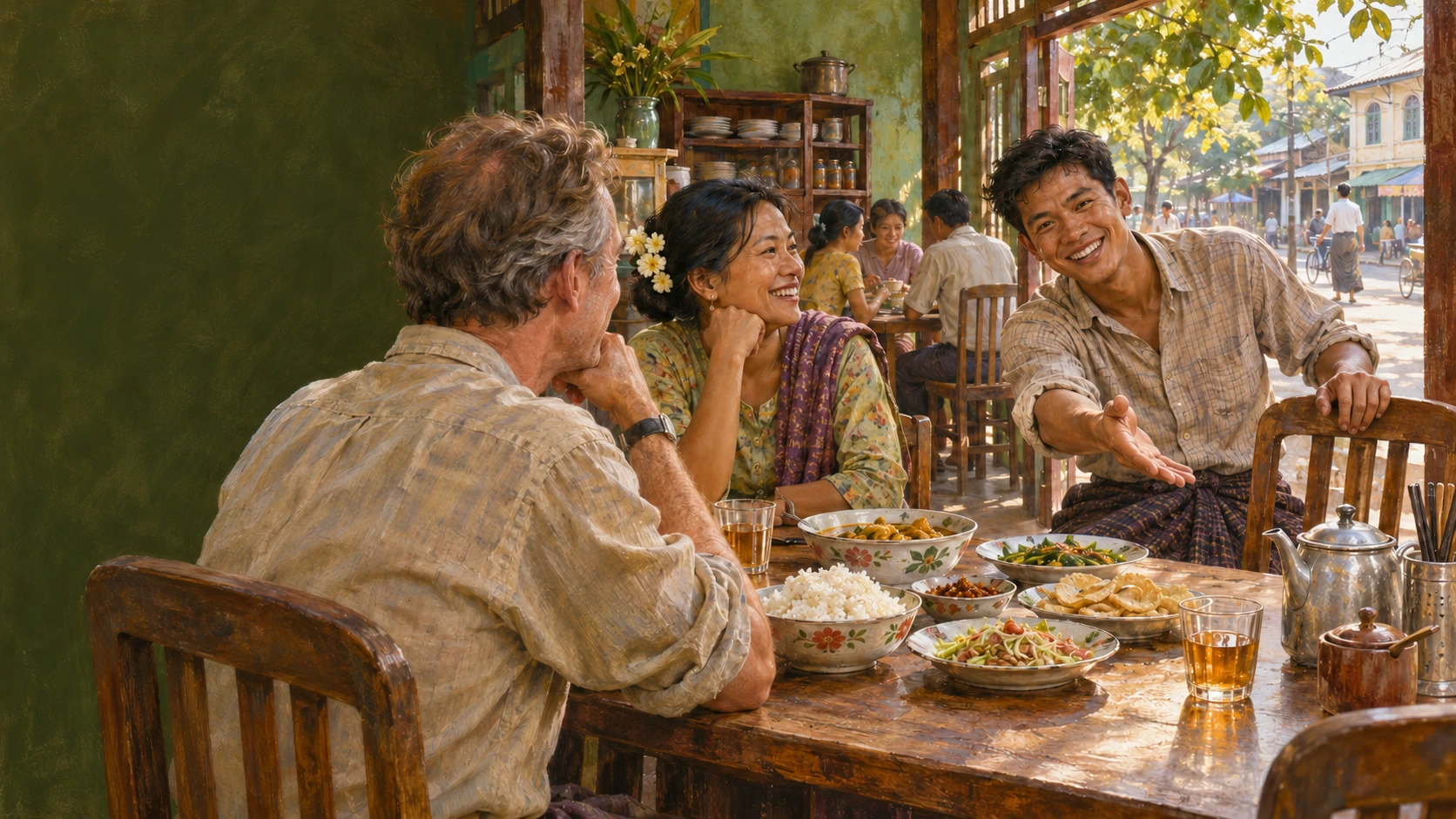
Header illustration: an imagined restaurant scene in Burma, not a record of the people or restaurant described.
When I opened a water shop in Noranda, I expected to sell water. I did not expect it to lead to a journey through Burma, a disagreement over a double bed, or a handsome young man who kept appearing wherever I went.
But business has often introduced me to things that were never in the business plan.
The shop came first. It was 2000, and I had recently returned to Perth after living in Malaysia, where I had learned the bottled-water industry and built a business. I had considerably more ideas than money.
A different sort of rent
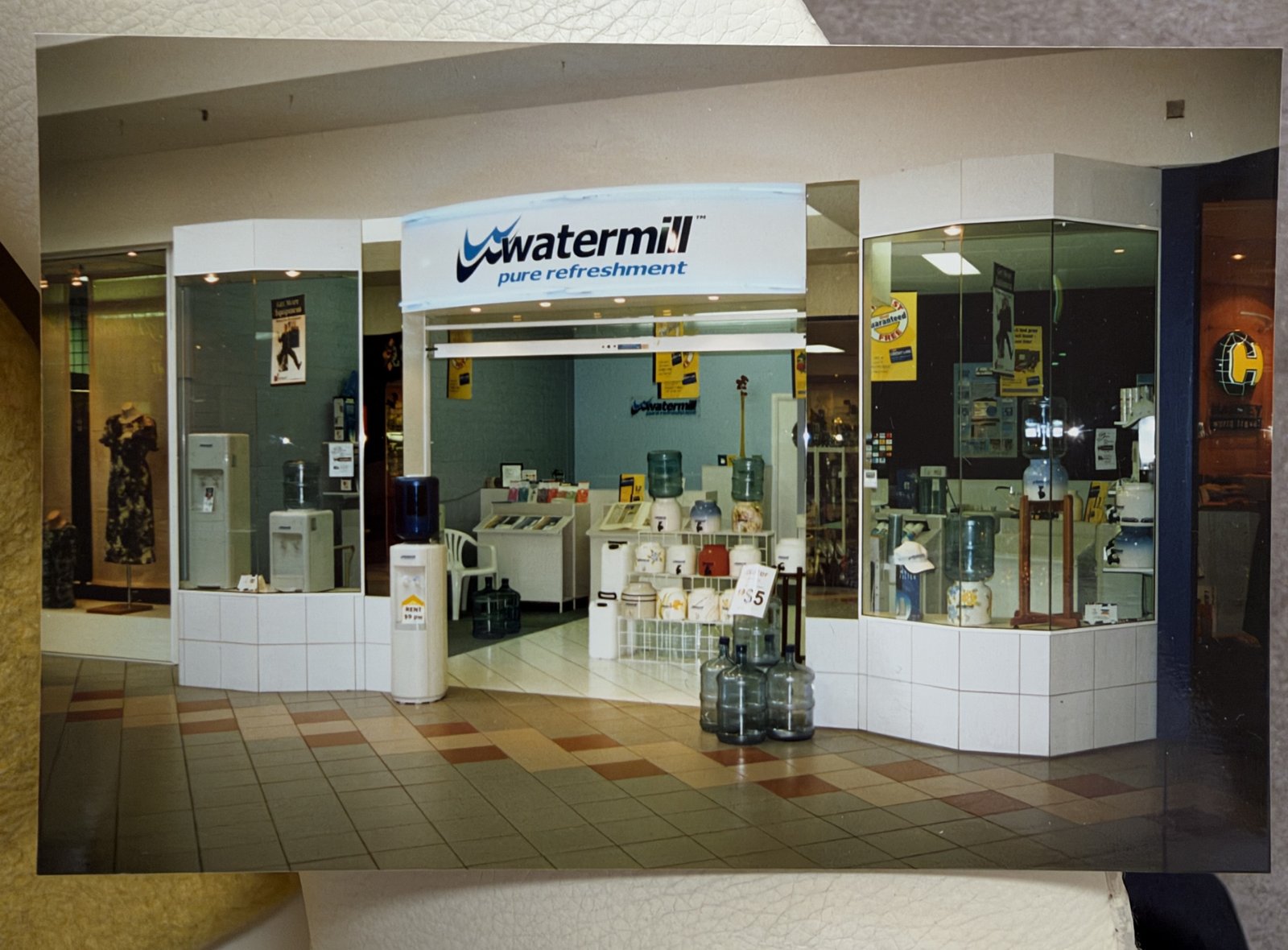
I found an empty shop at Noranda Palms Shopping Centre and saw a place for Watermill, selling filtered drinking water in 19-litre polycarbonate bottles. The landlord was Hawaiian Investments, a Singapore company that owned both Noranda Palms and The Park Centre in Victoria Park.
An empty tenancy earned them nothing. I had a business idea but little capital. Rather than commit to a fixed rent that might sink the shop before it had a chance, I proposed paying a percentage of my gross turnover.
They agreed. Better still, they gave me $5,000 towards the fit-out. That paid for filtration equipment, paint and signage, and allowed me to get started with very little money of my own.
The water came from the tap and passed through the filtration system. Customers paid a deposit on a bottle, then returned their empties in exchange for already-filled replacements. There was no waiting while I refilled a bottle at the counter; the full ones were ready to take away.
It was a modest business, but an arrangement I was pleased with. I had found a way to open the shop without first having to find a fortune.
Then a customer began bringing me lunch.
Nene Mar
Nene Mar was a Burmese woman living in Australia. Her husband had died a couple of years earlier. She came into the shop regularly, we got talking, and a friendship developed.
First she brought snacks, then cooked meals. And goodness, she could cook. Her Burmese food was delicious. I was supplying the water; she seemed to have taken responsibility for feeding the man who sold it.
At the time, I saw this as kindness between friends. My interest was entirely platonic, and I did not encourage anything more.
After the trip, I was convinced she had been hoping for a new husband. In hindsight, perhaps the lunches should have alerted me. The way to a man's heart is through his stomach, as the saying goes. Mine had enjoyed the food without receiving the rest of the message.
Eventually Nene told me she wanted to visit her family in Burma, or Myanmar, but did not want to travel alone. Would I go with her?
I was always susceptible to an invitation involving a country I had not seen. Travelling with someone who spoke the language and knew people there was especially appealing. I had someone who could run Watermill while I was away, so I agreed.
One room, one double bed
We stopped in Kuala Lumpur on the way, staying at a hotel in the Bukit Bintang area. At check-in, I discovered that Nene had booked one room with a double bed.
That was not the arrangement I had in mind.
I explained that we were not a couple and asked for a separate room. Only one had been booked, the staff told me, but eventually they found another.
Nene was not pleased. Then came the tears: she was frightened to stay in a room alone. What should have been a routine check-in became a scene in front of the hotel staff.
She stamped her feet and worked herself into a real hissy fit. She was beside herself. I found the performance extraordinary, but I was not going to give in. Sharing the bed would only encourage an expectation I did not share.
The solution was to arrange for a member of the hotel's live-in staff to stay in her room. I think the staff member slept on the floor, though that detail is less certain in my memory.
I slept in my own room.
Friends and nothing more
We travelled to other parts of Burma, returning to Rangoon between trips. Each time we came back, I paid for the company of a young woman during my stay in the city. I wanted Nene to see that I was a free spirit: our friendship was just that, and it was not going to become a romance.
My way of communicating my position may not have been subtle, but considering how unsubtle Nene was being, I considered it reasonable in those circumstances, and quite necessary.
With her family, I suspected she was presenting me as her husband, boyfriend or partner, perhaps to avoid losing face. Most of the conversation was in Burmese, which I did not speak, so that remains my impression rather than something I can confirm.
I did not challenge her in front of them. Between ourselves, I made clear that we were friends.
Dinner at her brother's flat
Those difficulties were only one part of the journey. Nene introduced me to lovely people, and the food alone would have justified the trip.
Her brother lived with his wife and two children in a flat in central Rangoon, in a building I remember as six or seven storeys high. The children, a boy and a girl, were beautifully behaved. They were educated at home, with a teacher coming to teach them.
We travelled with the family a little and visited some sights together. One day, back at the flat, his wife was preparing dinner when I went looking for the toilet. The door opened directly off the kitchen, an arrangement I was not used to, but it was the cooking that stopped me in my tracks.
She was kneeling on the floor. A few clay bricks supported a pot over burning charcoal in the middle of the kitchen. That was her cooker.
I had never seen anything like it in a domestic flat. Yet the meal she produced was quite honestly some of the best food I have eaten in my life. The equipment was simple; the flavours were wonderful.
Nene had already impressed me in Perth. Her family's cooking was every bit as good.
Rambo, apparently
I spent hours wandering around Rangoon with my camera, taking candid photographs in the older shopping areas. People often stopped to talk, sometimes trying out a little English.
One greeting surprised me: Rambo.
Goodness gracious. I do not look anything like Rambo. Perhaps the films were popular, or perhaps a white visitor with a camera was enough to suggest the connection. Whatever the explanation, it amused me.
My age produced another reaction. I was exactly fifty, having celebrated my birthday not long before we left for Burma. Some people, when invited to guess, put me at about twenty-eight. They seemed quite shocked when I told them.
I was not going to argue with the estimate.
Some people of my own age looked as though life had demanded far more of them. What struck me most, though, was how friendly people were and how readily they stopped to talk.
Petrol, palm trees and a gift
On one sightseeing trip we stopped for petrol. There was no pump: the car was filled from a canister through a funnel. While we waited, we went into a little shop where there was not much for sale, but a very warm welcome.
They had toddy-palm liquor. The man also showed us how he climbed the palm: straight up the towering trunk, without ropes, equipment or any helpful gadget. By the time he reached the fronds, he was almost a dot above us.
I watched in amazement, then looked for something to buy. The people appeared to have very little, and I wanted to leave some money with them. I did not particularly need anything, but the liquor would do. Whether it was properly called whisky, toddy or something else, I cannot now say.
Nene translated when I asked the price.
They did not want payment. They wanted to give it to me.
I was trying to help by buying something; they were trying to welcome me by giving it away. Eventually I insisted on paying. I had more kyat than I knew what to do with, and it seemed far better to leave some with people who could make good use of it. I did not drink and had no intention of drinking the liquor. I think I gave it to Nene's brother, to enjoy himself or pass on to someone of his choice. Their generosity stayed with me far longer than the purchase.
Umbrellas and British motorcycles
Rangoon had people who made a living repairing umbrellas. There was plenty of rain, plenty of umbrellas and, evidently, enough broken ones to keep them busy. At home, I would probably have thrown a damaged umbrella away. Here, someone could make it useful again.
Then I came across a motorcycle shop that held my attention for considerably longer.
It sold restored British bikes: BSAs, Triumphs and Nortons. These were original machines, rebuilt with such care that they looked almost new. I spent ages admiring the craftsmanship, finish and attention to detail.
There were beautifully restored Royal Enfields too. As I looked them over, the man in the shop explained, through Nene's brother, that they were not all vintage machines. Some were much more recent.
I had no idea Royal Enfields were still being made.
They were, he explained, in India. What I had thought of as a piece of Britain's motorcycling past was still coming out of a factory as a new motorcycle.
The connection went back to 1955, when Royal Enfield partnered with Madras Motors to form Enfield India. Licensed Bullet production began there in 1956, initially using kits from England, with more of the manufacturing gradually moving to India. The Indian operation carried on long after British production ended.
The conversation also brought up the Hindustan Ambassador, the familiar Indian taxi. That was another British design with a remarkably long second career: it was based on the Morris Oxford Series III, with the old design continuing in Indian production as the Ambassador.
The rounded bodywork and 1950s origins hardly suggested the last word in modern safety. Still, one must be fair. It had brakes.
I had gone into the shop to admire restored classics and discovered that some classics had never stopped being made.
Then I looked at the prices, and the businessman in me began calculating.
How could I get these bikes to Australia? A container full of restored British motorcycles suddenly seemed an excellent idea. I could already imagine the buyers.
I took photographs, collected the owner's card and address, and then did nothing further about it. There might have been an opportunity, but I never tested it. What I did find was a workshop full of skill and patience, producing motorcycles I would have been delighted to own.
Manufacturing history: Royal Enfield’s own timeline and the British Motor Museum’s Morris history.
The boy with the postcards
A little boy in one shopping area was equally determined to do business with me. He sold postcards, and followed me around offering them with a persistence that was difficult to ignore.
I did not want postcards. I had a camera and was making my own pictures. He was friendly and insistent, but I bought nothing.
Two days later I returned. He remembered me, and resumed negotiations as though we had merely paused for lunch.
Knowing I was not interested did nothing to discourage him. In the end, I bought a substantial bunch. I admired his persistence and wanted him to get something for his efforts.
There was an entrepreneur in that boy. I recognised the refusal to give up on a sale. I have often wondered what became of him, and hope his determination helped him to a good life. I hope he is still around, finding a way forward.
The familiar face
There was another person whose persistence I could not overlook.
Not long after arriving in Burma, I began to feel that someone was watching us. After a couple of days, I noticed a tall young man who seemed to appear wherever we went.
He was very handsome. I'm confident enough in my own masculinity to appreciate a good-looking man and say so without embarrassment.
Seeing him once meant nothing. Twice could still be coincidence. After a while, I began looking for him, and there he would be.
We took an internal flight from Rangoon, or Yangon, to another town whose name I cannot now recall. He was on the plane too.
That was a fairly determined coincidence.
Eventually, in a simple restaurant, I decided the arrangement had become silly. Nene and I were eating; he was at another table. I went over and invited him to join us.
He accepted, spoke quite good English, and proved pleasant company. My understanding from that encounter was that keeping an eye on us was his assignment. I cannot now establish his precise role or who had sent him, but that was how I understood it at the time.
We were there for a holiday and to visit Nene's family. I had nothing to hide. Sitting together over a meal seemed a considerable improvement on pretending not to notice one another.
He continued to appear for the rest of the trip. Perhaps he was reporting that we were no trouble. At least by then we could acknowledge each other.
A country remembered through its people
Watermill gave me the satisfaction of opening a shop when I had little money. Nene gave me the opportunity to see a country I might otherwise have missed. Our expectations of the journey were very different, but I remain grateful for the welcome I received.
I remember dinner cooked over charcoal on a kitchen floor, a man climbing a palm and then refusing my money, beautifully restored motorcycles and a boy who finally sold me his postcards. Even the young man I understood to be our official shadow turned out to be friendly company.
The people were warm, the country beautiful and the food wonderful. It saddens me to think of those people alongside the country's political and military troubles. I would love to return, but the situation would have to improve a great deal before I took that chance.
Perhaps I might even meet my handsome young minder again—still following me around, but needing a Zimmer frame to keep up.
A few bags of money later
The exchange rates, shopping bags full of kyat and unexpected encounter with Australian Customs have their own story: Shopping Bags Full of Money →.
For an earlier departure from Perth, read Three Hold-Ups Were Enough →. My water-business years in Malaysia also produced The Mysterious Case of the Vanishing Cow →.