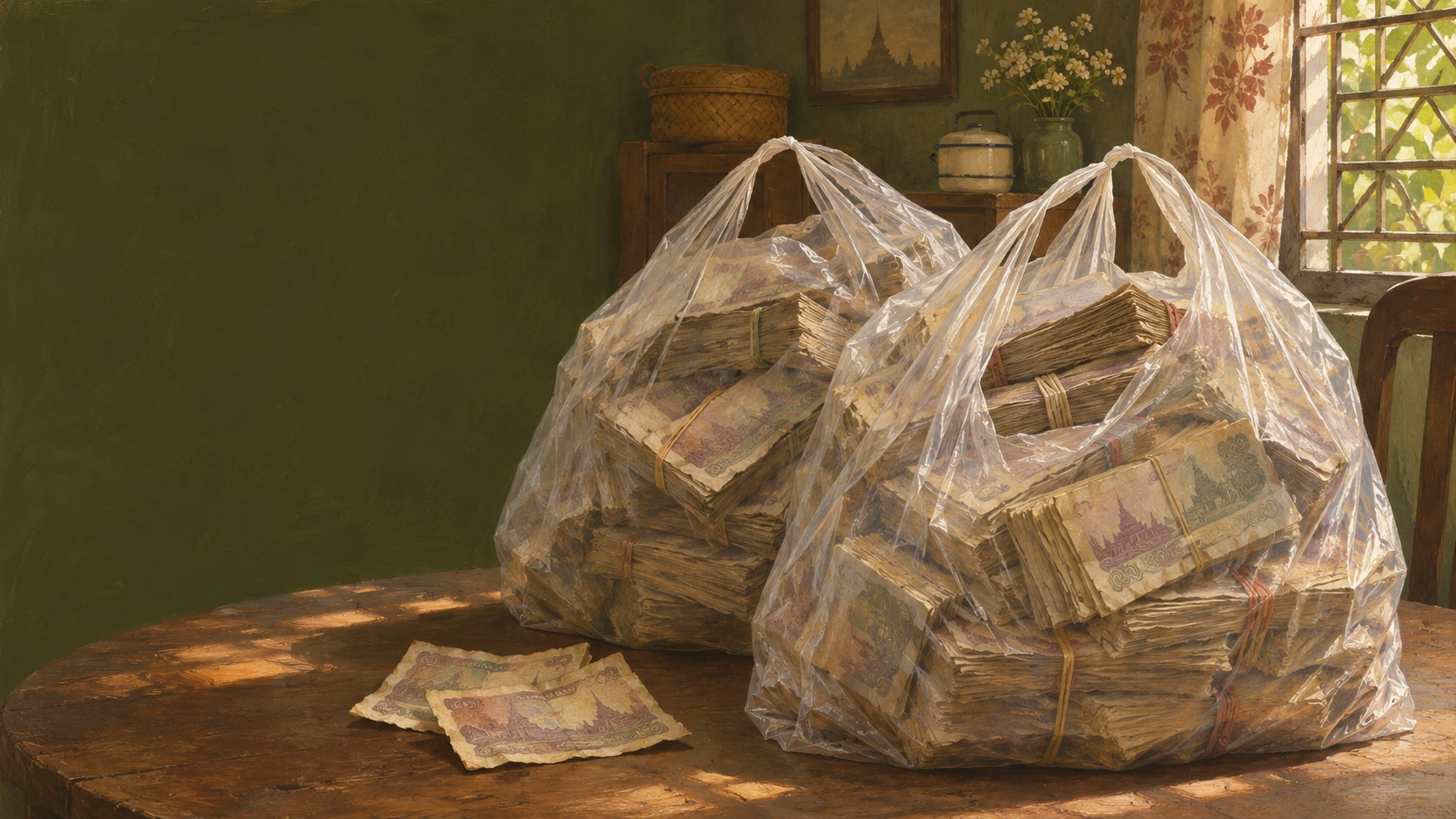
Header illustration: an imagined still life of bags of banknotes, not a photograph of my money or an exact reproduction of the notes.
I returned from Burma with a very large stack of banknotes and found myself spending hours at Australian Customs trying to explain that I was not rich.
The money had come through the brother of Nene Mar, the friend who had invited me to visit Burma with her around 2000. In Rangoon, he introduced me to an exchange rate that made a few foreign notes turn into shopping bags full of kyat.
Carrying the bags was extraordinary. Bringing the leftovers home proved considerably less enjoyable.
Shopping bags full of kyat
During one visit to her brother's flat, Nene handed him some money. I assumed it was a gift. He went out, then returned with a plastic shopping bag full of Burmese kyat and gave it to her.
He had changed the money on the black market. A few foreign notes had become a whole bag of local currency.
I took an interest in the family banking arrangements.
Before our next visit, I asked Nene whether he could change some money for me too. It may have been four or five hundred dollars; I am not certain now. What I do remember is receiving two shopping bags in return.
They were heavy. It is a wonder the plastic did not break. Whatever the notes were worth, carrying bags full of cash was an extraordinary feeling. There was something remarkable about having that much money in my hands.
I opened a bag and sniffed the notes. They smelled old, musty and damp, as though somebody had found them in an abandoned colonial mansion where they had lain in an airless room for a hundred years. I have never quite forgotten it.
Calling the black-market rate more favourable than the official rate would be the understatement of the century. The difference was enormous: chalk and cheese. As it turned out, I had changed more than enough already.
Nene's brother told me that some wealthy people in Rangoon had so much kyat they rented godowns—warehouses—and stacked the cash from floor to ceiling. After carrying my two shopping bags, I could begin to imagine the problem. A warehouse full of money was an impressive thought. Moving it would have been another matter.
It reminded me of Warsaw in the late 1970s. I had travelled to Poland with a friend, stayed at his brother's apartment and eaten with families. There, too, the black-market rate made my money go an extraordinary distance.
One day I ordered tea and an extravagant cake in a grand hotel in central Warsaw. I think it was called the Centrum Hotel, though I am uncertain of the name. Using the rate at which I had changed my money, I calculated that the tea cost two Australian cents and the cake four.
Six cents for tea and cake in a very upmarket hotel. With accommodation and so many meals taken care of, I found it almost impossible to spend what I had.
Burma brought that memory back. There had also been a compulsory exchange on arrival: I remember having to change US$200 through the official system. That arrangement involved Foreign Exchange Certificates, issued in dollar units. The bags her brother brought back contained ordinary kyat notes.
Historical exchange system: the Myanmar embassy’s period visitor information describes the US$200 requirement and Foreign Exchange Certificates →.
A fortune at the airport
By the time we left Burma, I still had a very large stack of kyat. Unsure what to do with it, I brought it back to Australia.
That was not a good idea.
I remember being held at Customs for at least two or three hours. They believed I had brought in more than A$10,000 worth of currency without declaring it. I explained that the notes were worth nowhere near that amount.
They consulted an airport money changer, and the valuation that came back to me was in the tens of thousands of dollars.
Apparently, I had become wealthy somewhere between Rangoon and the arrivals hall.
I suspect the figure came from an official exchange rate rather than the rate at which I had obtained the money. I cannot say which calculation they used. I reckoned the remaining notes were worth perhaps $200 at most.
They did not believe me. The federal police were called, and the waiting and explanations continued. There was a great deal of toing and froing. I felt accused and threatened, and became increasingly annoyed. As far as I was concerned, I had done nothing wrong.
Eventually I suggested that, if they really believed the valuation, they should take the notes to the money changer and collect the proceeds. Even half the quoted amount would do. I would happily split it with them.
If there was a fortune to be made, I was prepared to be generous.
After what I believe were further checks into the value, I was allowed to go. My understanding remained that the money was worth less than $200. I had spent hours trying to establish that I was not unexpectedly rich.
It put me off bringing home that sort of currency again. The notes themselves, however, have stayed with me. As I write this in 2026, about twenty-six years later, they are in Thailand, waiting in the rather vain hope that one day we might go back to Burma and use them.
How the journey began
The Watermill shop, Nene Mar, the people we met and my handsome travelling shadow appear in From Watermill to Burma →.