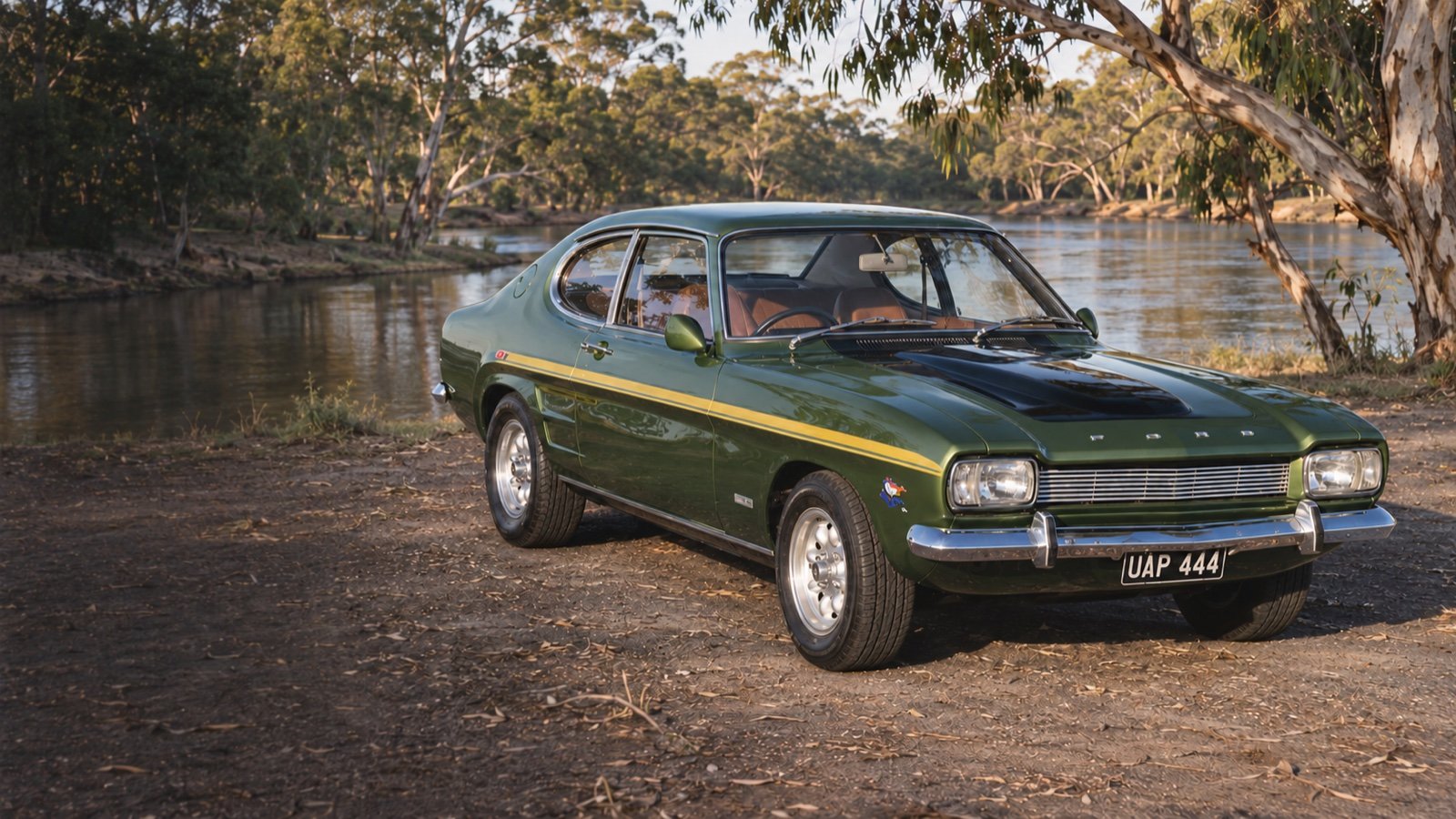
My first car in Australia was a green Ford Capri GT with a three-litre V6. I bought it in 1972. Only a few months earlier, I hadn’t even been sure I was staying.
I’d expected to go back to England to see Pam, my girlfriend. Then a letter arrived. She’d been seeing the chief riding instructor at the academy where she worked. That rather took care of my reason for going back. My family was in Australia, and I began to think of staying for good. Permanent residency came first, and citizenship later. In the meantime, I wanted a car.
Paid by the bracket
By day I worked in a factory, picking stock off shelves and loading orders into a little carriage that ran on tracks in the warehouse floor. I can’t remember what made it go, but it was the most interesting thing about the job. At night I earned extra money at the Jason Furniture factory in Kewdale, where I worked a press that bent metal brackets for furniture.
It was piecework. The press would hiss and chug, I’d toss another bracket into the bin, and the faster I filled it, the more I earned. I found I could do two at a time. The foreman was impressed by my numbers. I saw no particular reason to explain them.
Two went so well that I tried three. For about an hour I thought I was a genius. Then the press jammed and wouldn’t come back up. The foreman came over, took one look, and that was the end of my night job. I still thought they ought to have had a bigger press. Of course, I hadn’t the faintest idea how to build one.
My own three-litre GT
I’d saved a fair bit by then and was borrowing Dad’s Holden Brougham whenever I could. Then the Capri came up. A three-litre GT would have been well beyond me in England. Even if I’d scraped together the purchase price, the insurance would have finished me off. Here I was, barely settled in Australia, and I could buy one.
Mine was finished in Jewel Green acrylic with the GT’s satin-black blackouts. It had square headlights and a yellow stripe along each side. Just behind the front bumper, ahead of each front wheel, was a little Super Roo decal. The registration was UAP 444.
The first Australian Capris had 1.6-litre four-cylinder engines. Ford introduced the 3000 GT here in 1970, with a 2,994 cc V6 rated at 144 brake horsepower. The cars came from Britain in kit form and were assembled at Ford’s Homebush plant in Sydney. Just over 3,000 of the V6 GTs were built before Australian Capri production ended in 1972.
I’d been used to four-cylinder engines, and the V6 sounded so much smoother. You could hear the difference straight away. And it went like a rocket.
I loved it, so naturally I had to fiddle with it. I had a Weber carburettor fitted with a straight-through air cleaner. When I put my foot down, there was a wonderful roar as the Weber drew in air. People talk about the sound of an exhaust. I’d have paid to hear the noise coming from the other end.
I think I bought the Capri from Winterbottom Motors in Perth. I remember taking it back after some work on the front struts. Every time I went over a bump there was a hell of a clunk. When I took it in again, I found the nuts that should have secured the tops of the struts sitting loose in the engine bay. They fixed it, but I was angry the car had been let out like that.
My girlfriend at the time and I did a fair bit of driving in it. We found a few quiet places to park, too. It was a good car to be young in.
It never felt quite the same
The Capri used to sit outside my coffee shop on Murray Street. One day a car ran into the line of parked cars and shunted mine up against the Volkswagen in front. I’ve told the full story in The Scarlet Pimpernel.
Insurance paid for the repairs, but after that the Capri always felt like a car that had been damaged. That’s what I told myself when I sold it, anyway. Was it the reason or the excuse? I think the next car was a Jaguar, and I can’t honestly say I’d have been very good at resisting one.
The header is a reconstruction based on a reference photograph.